
Spain's digital freight documentation mandate drives adoption despite readiness challenges, TransFollow and IRU webinar finds
Industry leaders highlight how digitalisation is improving operational efficiency, while uneven adoption, customer readiness and interoperability challenges remain as Europe prepares for eFTI.
Spain's mandatory digital freight documentation requirements have exposed significant differences in industry readiness, according to transport operators and industry representatives speaking at a webinar hosted by TransFollow and the International Road Transport Union (IRU).
Despite these challenges, participants highlighted the benefits of digitalisation and the importance of preparing for upcoming regulatory changes across Europe.

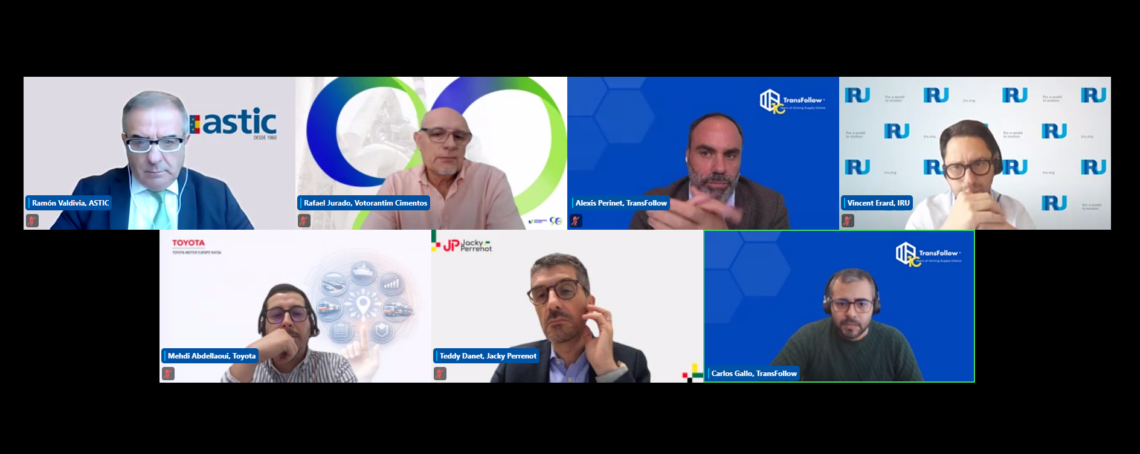
Webinar speakers: Alexis Perinet-Marquet (TransFollow), Carlos Gallo (TransFollow), Mehdi Abdellaoui (Toyota), Ramon Valdivia (Astic), Rafael Jurado (Votorantim Cimentos), Teddy Danet (Jacky Perrenot)
Long-term benefits of digitalisation should be the priority
The webinar, held on 21 October with approximately 500 registrations, examined the introduction of Spain's electronic administrative control document (DeCA) on 5 October and preparations for the European Union's Electronic Freight Transport Information (eFTI) Regulation.
"Spain's new legislation represents an important step forward for freight digitalisation, requiring businesses to reconsider how they manage and exchange transport documentation," said Carlos Gallo, Country Manager Spain, TransFollow.
"While compliance with DeCA is the immediate priority, businesses should also be considering the longer-term opportunities that digitalisation presents, from reducing administrative workloads to improving collaboration across supply chains."
A poll of attendees revealed that 40% still relied exclusively on paper transport documents, while 24% were piloting digital solutions, 20% had introduced them on selected operations, and 16% were mostly digital.
Ramón Valdivia, Executive Vice President, Asociación del Transporte Internacional por Carretera (ASTIC), reported that 64% of surveyed members had systems capable of generating the required QR codes, but many customers remained unprepared for the transition.
"We strongly believe in digitalisation, as our history demonstrates, but we believe companies should embrace it due to its advantages, not simply because governments make it compulsory," said Valdivia.
He warned that compliance alone would represent a missed opportunity, arguing that the greatest commercial benefits would come from digitalising relationships between transport companies and their customers.
ASTIC's survey also found that 42% of respondents reported no difficulties using electronic documents on domestic journeys, while 24% reported that more than half of their journeys had not complied with the new digital requirement during the initial fortnight.
Experiences from those who already went digital: Toyota, Jacky Perrenot, Votorantim Cimentos
Teddy Danet, Group Chief Information Officer, Jacky Perrenot, explained that the transport and logistics group, which operates more than 6,000 vehicles across eight countries, had begun implementing digital documentation before regulatory deadlines required it.
"When the authorities set a deadline, it pushes the whole ecosystem forward," said Teddy Danet.
"The transition is shorter, and that is better, because we avoid living for a long time with mixed solutions, some on paper, some digital, that are not always compatible."
Teddy Danet emphasised the importance of providing drivers with a single application capable of accommodating different customer requirements, rather than introducing separate systems for individual shippers.
The webinar also heard from Votorantim Cimentos, represented by Rafael Jurado Hornero, South and Canary Islands Logistic Manager, which reported generating approximately 1,300 electronic consignment notes in a single day across its Spanish operations.
Mehdi Abdellaoui, Senior Specialist, Supply Chain Systems Engineering, Toyota, explained that digital freight documentation formed part of the manufacturer's wider efforts to eliminate unnecessary administrative processes and improve information sharing between supply chain partners.
"Within Toyota, digitalisation is not an objective on its own," said Abdellaoui.
"The objective is to have a better, leaner process. With the current paper process, we have a lot of non-value-added activities, such as scanning, archiving, and retrieving documents."
Abdellaoui added that interoperability between different systems remained essential to ensuring that shippers, carriers, and receiving parties could access the same information without introducing additional administrative burdens.
Regulatory developments accelerating digitalisation
The discussion then turned to eFTI, under which EU Member State authorities will be required to accept qualifying electronic freight transport information from 9 July 2027.
"Spain is demonstrating how regulatory developments can accelerate the transition towards digital freight operations, but the benefits of digitalisation extend well beyond meeting individual national requirements," said Alexis Périnet-Marquet, Managing Director, TransFollow.
"With eFTI approaching, businesses across Europe have an opportunity to invest in interoperable digital solutions that improve efficiency, strengthen collaboration, and prepare them for future regulatory requirements."
The webinar was moderated by Vincent Erard, Senior Director Strategy and Development, IRU.
TransFollow provides digital freight documentation solutions that enable carriers, shippers, freight forwarders, and logistics providers to create, exchange, and manage electronic transport information.
Read more about successful implementations of digital transport documents with TransFollow here.