
October 2026 is the date of the new legislation: Documento Electrónico de Control Administrativo (DeCA), which imposes the obligation to switch from paper documents to digital ones. Lack of compliance may result in fines from €400 to €6,000 or an immediate immobilization of the vehicle and the cargo. Learn more about the new law.
Key takeaways
- The Documento Electrónico de Control Administrativo (DeCA) is now in force in Spain since October 5th 2026.
- The new Spanish legislation requires digital documents to be carried during domestic transport and cabotage within Spain. Paper documents are no longer valid.
- Documents must be generated from digital data. A scan of paper documentation is not valid.
- Documents must be available through a link or QR code that does not require authentication for the entire duration of the transport plus seven calendar days. The documentation must also be stored for at least one year after the transport is completed.
- Liability for the document is shared between the shipper and the carrier.
- Non-compliance may result in fines ranging from €400 to €6,000 and/or immediate vehicle impoundment.
- You need a digital transport document management platform that complies with the Spanish requirements, and all stakeholders must know how to use it.
TransFollow provides a digital document solution compliant with Spanish law. You can use our document management software for both domestic and international transports.
What do you need to know about Documento de Control Administrativo?
- When? The Documento de Control Administrativo (DeCA) has been in effect since 5 October 2026.
- Who needs to comply? Parties transporting goods domestically in Spain and through cabotage.
- What changes? Digital documents become the only valid version. Having paper documents only counts as not having proper documentation at all.
- Who is responsible for the documentation? The data must be input completely – this includes information from both the carrier and the shipper/client.
Crucially, "digital" means native electronic data. A scan of a document or its paper version will not be valid and will be treated as a lack of required documents. The paperwork needs to be generated directly from digital data and shared via an open-access link or QR code. The link must remain active for the entire duration of the transport plus seven calendar days after delivery.
What about international shipments?
The mandatory digital DeCA applies exclusively to domestic transport within Spain and domestic cabotage legs executed by foreign carriers. For pure cross-border international operations (e.g., transporting goods from France directly into Spain), standard international regulations remain unchanged: your transport is governed by the CMR framework.
However, the moment a foreign truck completes its international delivery and picks up a new, purely internal load to carry between Spanish locations, that movement constitutes cabotage – triggering the mandatory digital DeCA requirement alongside the accompanying international CMR.
What are the fines for non-compliance with the new road-transport law in Spain?
The new legislation defines the following fines:
| Offense type | Example | Fines |
|---|---|---|
| Minor offenses | Minor errors, formal errors in documentation | €400 to €600 |
| Serious offenses | Failure to carry the documents, providing documentation with incomplete information, carrying only paper documentation | Up to €2,000 |
| The most serious offenses | Falsifying documentation, fraud, refusing access to the inspector | Up to €6,000 |
Additionally, the most serious offenses might result in immediate vehicle impoundment.

How to prepare for the new transport law in Spain as a carrier?
First and foremost, you need to ensure your digital transport document management system is up to the Spanish standards. Depending on the type of operations, you will need:
- Mandatory: a system compliant with the digital DeCA requirements.
- Optional, for international shipments: an eCMR system compliant with the new Spanish legislation that can be used for both domestic and international transports.
Additionally, you need to make sure everybody included in the process knows how to use your platform and double check whether the solution is compliant. We've prepared a carrier compliance checklist to help you out with that. ⤵️
Carrier compliance checklist
Do you have routes that are affected by the Documento Electrónico de Control Administrativo?
- Do you carry out transports domestically in Spain?
- Do you carry out cabotage operations in Spain?
Is your system ready?
- Do you have a digital transport document management solution in place?
- Is your solution compliant with the new law?
- Can the documents be generated from structured data into a PDF?
- Can the documents be shared offline (e.g., via a QR code)?
- Are the links to the documents available without authentication?
- Are the documents shared available for the entire duration of the transport plus 7 calendar days after delivery?
- Are the documents stored for at least a year after delivery?
Do all stakeholders have access to the system?
- Shippers / Consignors,
- Logistics planners / Dispatchers,
- Freight forwarders / Subcontractors,
- Warehouse staff,
- Fleet / Compliance managers,
- Drivers.
What you need as a shipper
To keep your supply chain moving without legal interruptions, shippers must prepare their operations to meet three core requirements:
- Structured data creation – ensuring you have a system in place that can structure the data input into it and generate the documents under control.
- Archiving – using a system that stores the data for at least a year after the transport is completed, since this is a mandatory requirement in the new Spanish law.
- Stakeholder readiness – training your warehouse staff, dispatchers, and external logistics partners on how to use said systems to generate, share, and sign digital documents.
What to do if you're not ready?
If you did not check all the boxes on our checklist, you need to react immediately – the law is already in force. TransFollow's digital control documents and eCMR are compliant with the new Spanish law. We offer a solution for domestic transport & cabotage listed in the DeCA, as well as for international shipments. What does it bring to the table?
- Efficient digital document creation, storage, and archiving.
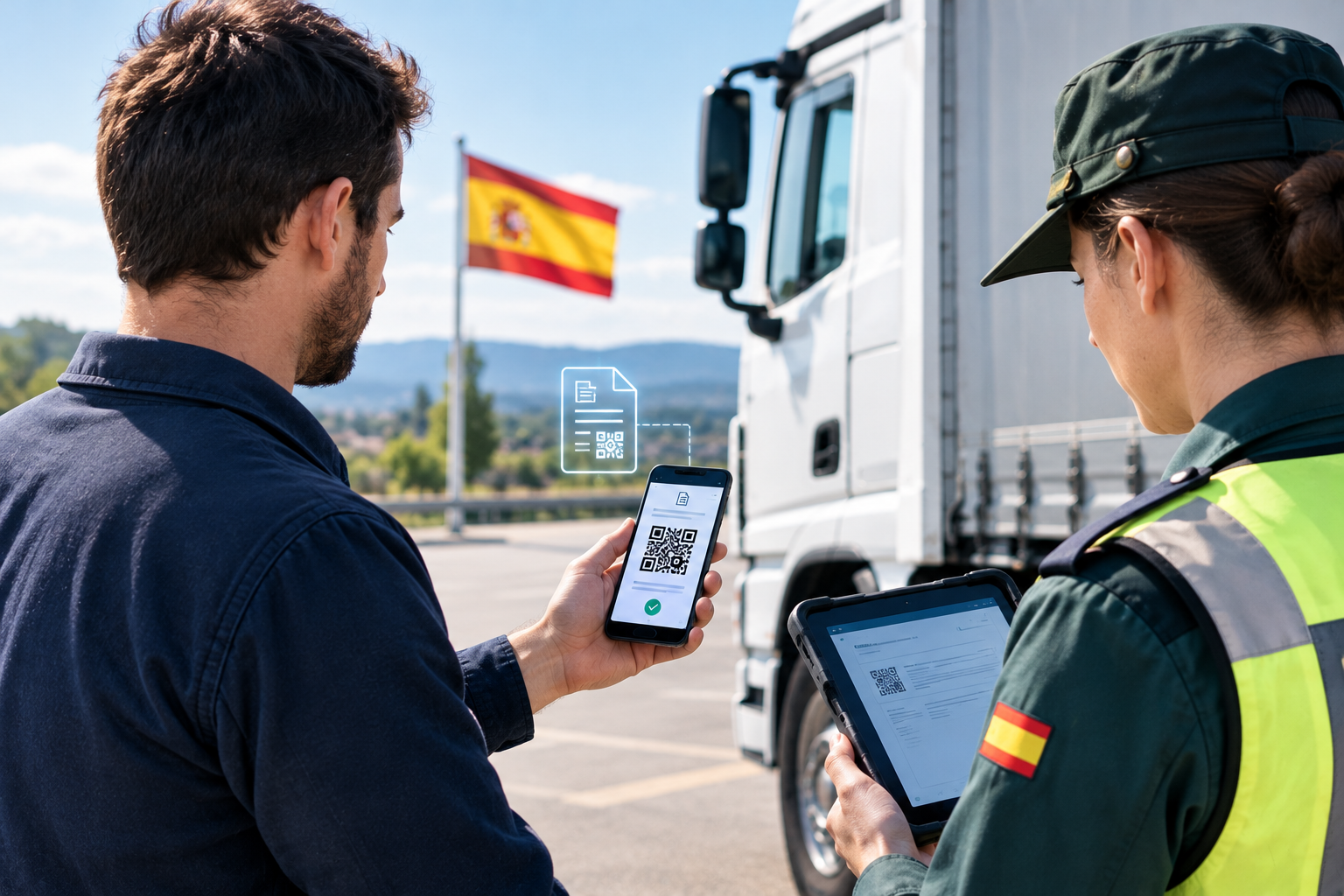
- Instant access for inspection via mobile devices, QR codes, and secure links.
- Compliance with local and international Spanish law.
- Real-time data sharing.
Moreover, our platform can easily be integrated with ERP, TMS, and WMS platforms – you can launch it quickly and be compliant in no time. Don't wait – contact us now and learn more about our digital control documents and eCMR in Spain!
The bottom line
The clock is ticking. Digitalisation of transport documentation is no longer optional in Spain. It's the last moment to invest in digital platforms for document management and maintain supply chain integrity, while avoiding fines. Verify your readiness across our checklist and react if necessary. Only through such measures will you avoid the potential legal, financial and business consequences!
References
- https://www.transportes.gob.es/transporte-terrestre/profesionales-transporte/servicios-transportista/documento-electronico-control-administrativo-deca
- https://expo.rs/spain-deca-electronic-document-transport/
FAQ
How does a driver present the digital document to road inspectors during a roadside check?
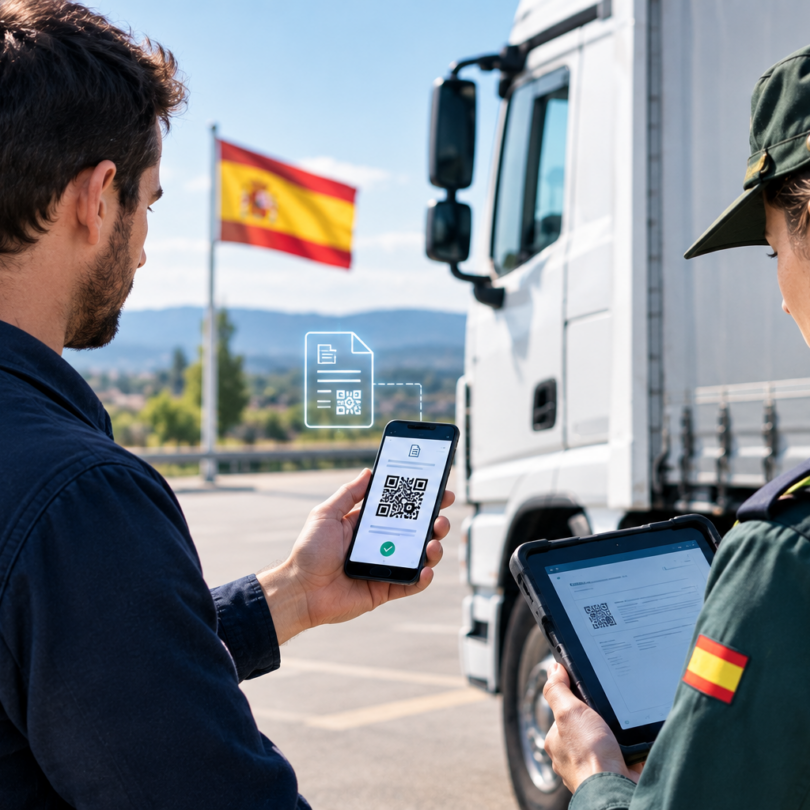
The driver simply displays a QR code on a smartphone or tablet screen, allowing inspectors to scan and retrieve the document instantly without needing to log in.
Does the driver need an internet connection during a road control to display the DeCA?
No, a continuous internet connection is not mandatory for the driver. Spanish regulations allow displaying the DeCA via a valid QR code/link, or a PDF stored on a mobile device – the link needs to work once the connection is restored.
What happens if the driver's phone battery dies during a Guardia Civil inspection?
If the driver cannot present the digital document immediately due to a dead device or technical failure on their side, it is treated as a technical non-compliance issue. This can lead to penalties of up to €2,000 or temporary vehicle detention until the digital record can be validated by the carrier.
Does the October 2026 DeCA mandate apply to foreign carriers performing standard international transport into Spain?
The DeCA regulation specifically targets domestic transport within Spain and cabotage operations. Standard cross-border international shipments are governed by the eCMR convention.
As a shipper, can I be held directly liable for fines if a carrier gets stopped without a compliant DeCA digital document?
Yes, under Spanish transport law, liability for generating and issuing the control document is shared jointly between the contractual shipper and the carrier.
What happens if a shipment involves multiple pickup or delivery points under a single transport contract?
A single DeCA can cover multiple shipments as long as the contractual shipper and effective carrier remain the same and all individual origins, destinations, and goods are clearly listed.